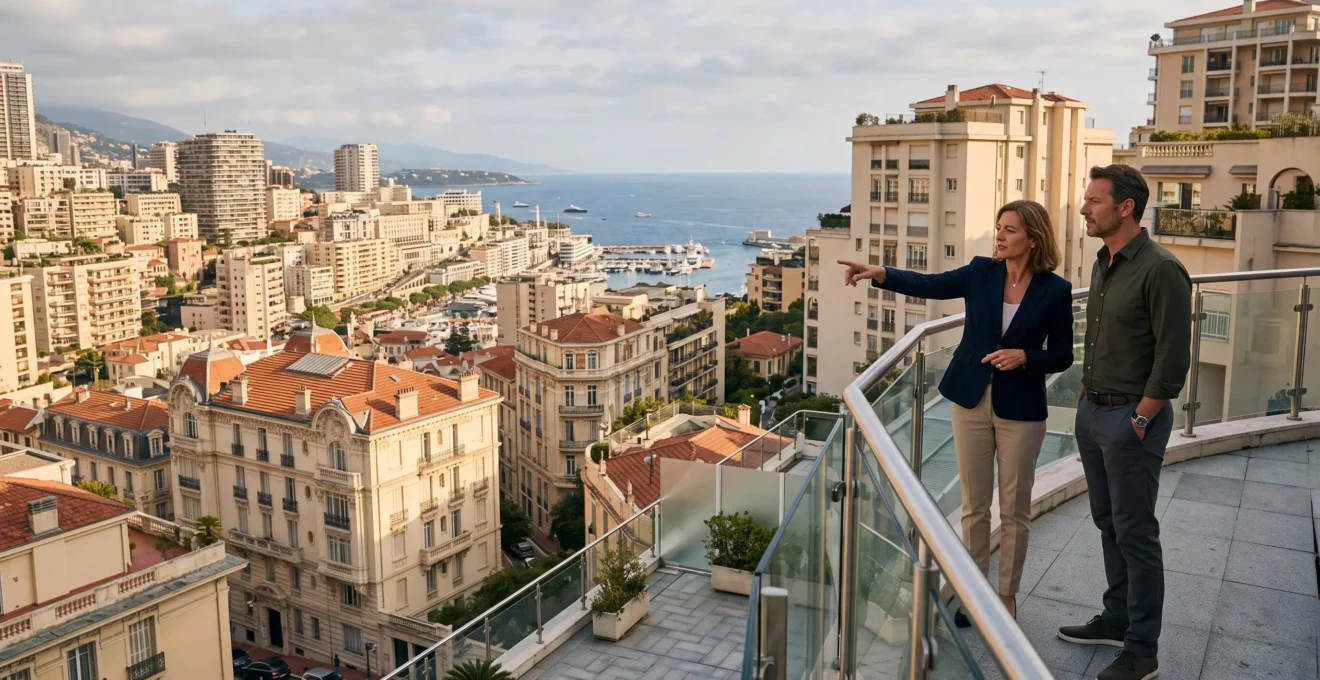
The Monaco real estate market operates on principles fundamentally different from most international property destinations: scarcity is not an incidental constraint but the defining structural feature that shapes every aspect of the search. With supply tightly restricted by the Principality’s 2 km² territory and sustained international demand, finding a prime apartment in Monte-Carlo is less about discovering hidden inventory than about understanding how value is formed, which district aligns with your criteria, and how the administrative framework governs non-resident acquisitions. The buyer who prepares thoroughly—clarifying decision criteria, mastering the logic of Monegasque pricing, and securing reliable local support before the search accelerates—competes more effectively than one reacting to scarcity without a clear evaluation method.
The Monaco Real Estate Market at a Glance: Scarcity, Prices and Demand
Monaco’s residential market recorded 493 property transactions in 2025, representing a 5.8% increase over the previous year, for a total transaction volume of €5.9 billion—a figure that remained stable compared to the record set in 2024, according to the IMSEE Observatoire de l’immobilier. These figures, published by the Institut Monégasque de la Statistique et des Études Économiques, illustrate the fundamental constraint facing any international buyer: the Principality’s housing stock turns over slowly, with fewer than 500 residential units changing hands annually in a jurisdiction whose entire territory spans just 2 km². The implication for a prospective buyer is immediate—waiting for the perfect property to appear organically is a less viable strategy than preparing criteria in advance and acting decisively when a suitable apartment becomes available.
International demand remains sustained, driven by the confluence of political stability, lifestyle appeal, and the fiscal framework often cited by cross-border investors, though every prospective buyer’s personal tax treatment must be verified with qualified professionals before any commitment. The Principality’s seven officially designated districts—Monaco-Ville, Monte-Carlo, La Condamine, Fontvieille, Larvotto, Les Moneghetti, and Saint-Roman—each present distinct profiles in terms of standing, atmosphere, and proximity to amenities. For buyers exploring available inventory, the Flat, Apartment for sale or rentals Principality Of Monaco page offers a starting point for surveying current listings and understanding the range of properties marketed in the Principality.
Price levels in Monte-Carlo are among the highest per square metre in Europe, though precise averages vary by district, building vintage, floor level, and the presence of premium services such as concierge, direct sea views, or proximity to the Casino district. The IMSEE employs a regression model accounting for sale date, construction period, and transaction type to estimate representative pricing, but individual apartment valuations depend heavily on attributes that official aggregates cannot fully capture. The practical takeaway: headline price per square metre figures serve as a frame of reference, not a substitute for independent valuation of the specific property under consideration.
Which District Should You Choose for a Prime Flat or Apartment in Monte-Carlo?
District selection in Monaco materially affects not only daily lifestyle but also price levels, liquidity upon resale, and access to specific amenities. The Carré d’Or, the central district surrounding the Casino de Monte-Carlo and the Hôtel de Paris, represents the traditional heart of Monegasque prestige: Belle Époque façades, luxury retail, Michelin-starred dining, and walkable access to cultural landmarks. Apartments here command premium pricing justified by location and the concentration of services, though space can be constrained and street-facing units may experience higher ambient noise.
Larvotto, the beachfront district to the east, attracts buyers prioritising proximity to the sea, the Larvotto beach complex, and the Japanese Garden. Properties here range from modernist residential towers with direct sea views to mid-rise buildings set slightly inland. The district offers a more residential atmosphere than the Carré d’Or while retaining proximity to Monaco’s centre, making it a natural choice for buyers balancing prestige with a quieter, family-oriented environment.

Fontvieille, the westernmost district built on reclaimed land in the 1970s and 1980s, presents a distinct architectural profile: modern residential complexes, marina berths, the Princess Grace Rose Garden, and the Stade Louis II. The district offers comparatively more recent construction, integrated parking, and a planned urban layout, appealing to buyers who value modern amenities and accessibility over historic character. Fontvieille properties often trade at a relative discount to equivalent-sized units in the Carré d’Or or Larvotto, though liquidity and resale timelines may differ.
Les Moneghetti and the upper hillside districts—Saint-Roman, Les Révoires—occupy the slopes above the Principality’s central corridor. These areas provide greater residential calm, often panoramic views over the port or the Mediterranean, and buildings with terraces and green spaces less common in the densely built core. The trade-off lies in accessibility: reaching the Carré d’Or or La Condamine typically requires driving or a series of public elevators, which may matter to a buyer prioritising walkability. The decision framework is straightforward: if prestige, central location, and proximity to cultural and commercial amenities are paramount, the Carré d’Or and Larvotto waterfront merit priority; if space, views, and tranquillity outweigh immediate walkability, the upper districts warrant serious consideration.
What Are the Rules for Buying Property in Monaco as a Non-Resident?
Foreign nationals, whether residing in the Principality or abroad, may acquire residential property in Monaco, though the process involves administrative steps distinct from those in many other European jurisdictions. Ownership itself is not restricted by nationality, but securing residency in Monaco—should that be the buyer’s objective—requires meeting separate criteria, including proof of adequate financial resources and possession of a valid residence within the Principality. The official residence certificate procedure published by the Government of the Principality details the documentation required for foreign nationals holding a valid residence permit, a status that presupposes prior approval and does not automatically flow from property ownership.
The acquisition process itself follows a structured timeline overseen by Monegasque notaries, legal professionals who hold a statutory monopoly on authenticating real estate transactions in the Principality. Upon acceptance of an offer, the buyer and seller typically enter into a preliminary agreement—a compromis de vente—which sets the final sale price, outlines conditions precedent, and establishes a timeline for completion. A deposit, often 10% of the purchase price, is held in escrow pending satisfaction of all conditions. The notary conducts title searches, verifies that no encumbrances affect the property, and ensures that all regulatory authorisations are obtained before the final deed—the acte de vente—is executed.
Fiscal and regulatory disclaimer: All information concerning fiscal treatment, residency requirements, and administrative procedures presented in this article is indicative and subject to change. The tax consequences of owning property in Monaco depend on the buyer’s country of residence, nationality, and individual circumstances. Every prospective buyer must verify all fiscal, legal, and regulatory aspects with licensed Monegasque professionals—notaries, tax advisors, and legal counsel qualified to practice in the Principality—before making any commitment.
Transaction costs in Monaco include notary fees, registration duties, and agent commissions, which collectively add several percentage points to the headline purchase price. Notary fees are regulated and calculated on a sliding scale based on the property value; agent commissions, when applicable, are negotiable but customarily borne by the seller in many transactions, though this must be verified in each case. The buyer should budget for these ancillary costs from the outset, as they materially affect the total capital outlay required to complete the acquisition.
How to Evaluate the True Value of an Apartment in Monte-Carlo
Determining fair value for a prime apartment in Monaco requires cross-referencing the asking price against recent comparable transactions, adjusting for the specific attributes that drive pricing in the Principality, and independently verifying the property’s physical condition and legal standing. Official transaction data, published periodically by the IMSEE and tracked by recognised prime real estate observatories, provides a baseline: median or average price per square metre by district and construction period. These benchmarks are useful for detecting gross overpricing but insufficient on their own, because two apartments of identical surface area in the same building can command materially different prices based on floor level, orientation, view quality, and interior condition.
The primary value drivers in Monte-Carlo are location within the district, floor elevation, sea or harbour views, building services, and the presence of outdoor space. A high-floor apartment with unobstructed sea views in a full-service building—24-hour concierge, secure parking, swimming pool—will trade at a significant premium to a lower-floor unit facing an internal courtyard in a walk-up building without amenities, even if both share the same postal address. Buyers accustomed to markets where price per square metre varies primarily by neighbourhood must recalibrate their valuation method to account for these building-specific and unit-specific attributes.

Annual co-ownership charges—charges de copropriété—represent another critical component of total ownership cost and a proxy for the building’s service level and maintenance standards. A luxury building with full-time staff, extensive common areas, and high-specification installations will carry proportionately higher annual charges, sometimes reaching several tens of thousands of euros per year for larger units. These charges are recurring, non-negotiable, and must be factored into the long-term cost of ownership. Requesting the building’s most recent financial statements and reviewing the breakdown of charges before making an offer is standard due diligence in the Monegasque market.
Professional valuation—conducted by a qualified surveyor or real estate expert familiar with Monaco’s specific market dynamics—serves as the final safeguard against overpaying. Independent valuation is especially prudent for buyers acquiring remotely or for the first time in the Principality, as it provides an objective benchmark grounded in recent transaction comparables and granular knowledge of building quality. Valuation is not only a purchase tool but also a resale and estate-planning asset, making it a worthwhile investment at every stage of the property cycle.
Monaco Within the Broader International Investment Landscape
Monaco occupies a distinct position within the European prime residential market, characterised by structural supply constraints unmatched by other prestigious coastal destinations. Whereas markets such as the French Riviera, the Italian lakes, or Spain’s Mediterranean coast offer periodic new development and greater geographic dispersion of prime stock, Monaco’s 2 km² territory and strict planning regulations mean that new residential supply arrives in discrete, infrequent increments—often linked to large-scale land reclamation or urban renewal projects spanning multiple years. This supply rigidity underpins price stability over the long term, though it also limits the absolute number of transactions and can extend search timelines for buyers with highly specific requirements.
International capital flows into Monaco reflect the Principality’s appeal as a jurisdiction combining political stability, personal security, a favourable regulatory environment, and proximity to major European cities. Cross-border investors from Europe, the Middle East, Asia, and the Americas view Monegasque real estate as a store of value and, for some, a platform for eventual residency. Understanding these broader trends in international real estate investing helps situate Monaco within the portfolio strategies of high-net-worth individuals diversifying across multiple prime markets.
The comparative lens reveals that Monaco’s pricing reflects not only location and lifestyle but also scarcity premium and regulatory certainty. Buyers evaluating Monaco alongside other international destinations should weight these factors explicitly: the Principality offers unmatched density of services and infrastructure within a secure, stable framework, but at price levels and co-ownership costs that exceed most competing markets. The decision is ultimately one of priority—whether the unique combination of attributes Monaco offers justifies the premium, and whether the buyer’s lifestyle and financial objectives align with the Principality’s specific profile.
Next Steps: Securing Your Prime Apartment with the Right Local Partner
Converting market knowledge into a successful acquisition requires a structured pre-purchase process and reliable local support covering search, valuation, legal verification, and post-acquisition management. The first step is defining clear criteria: budget (including transaction costs and annual charges), preferred district, minimum and maximum surface area, floor level and view requirements, and any building services considered essential. Writing these criteria down and assigning each a priority—mandatory, preferred, or flexible—prevents search drift and enables rapid decision-making when a suitable property appears.
The second step is selecting a local partner who can provide integrated support across the acquisition cycle. In Monaco’s tightly networked market, the same firm often handles initial search, preliminary valuation, negotiation support, liaison with notaries and legal counsel, and ongoing property management or rental administration if the buyer does not intend full-time occupancy. The partner’s local knowledge—familiarity with building reputations, co-ownership dynamics, pricing trends by micro-location, and relationships with institutional actors—materially affects both the speed and the terms of a successful acquisition.

Pre-purchase checklist: key steps before committing
- Define budget inclusive of transaction costs, notary fees, and first-year co-ownership charges
- Shortlist districts based on lifestyle priorities: central prestige versus residential calm, walkability versus views
- Verify all asking prices against recent comparable transactions using official data sources or independent valuation
- Request and review the building’s financial statements, co-ownership regulations, and recent assembly minutes
- Confirm administrative and fiscal obligations with licensed Monegasque professionals before signing any preliminary agreement
- Arrange independent property inspection and legal title verification through qualified local counsel
- Secure financing pre-approval if applicable, ensuring the timeline aligns with Monaco’s standard transaction calendar
The final pre-commitment step is fiscal and legal verification. Every aspect of the buyer’s personal tax situation—country of residence, citizenship, intended use of the property, and estate planning considerations—must be reviewed with professionals qualified to advise on both Monegasque law and the buyer’s home jurisdiction. The attractive fiscal framework often associated with Monaco applies primarily to individuals who become residents of the Principality and meet specific conditions; non-resident owners remain subject to the tax rules of their country of residence, and assumptions based on incomplete information can prove costly. Engaging qualified counsel early, before signing the compromis de vente, ensures that the acquisition structure aligns with the buyer’s broader wealth and succession planning.
Securing a prime apartment in Monte-Carlo is achievable for the well-prepared international buyer who understands that success in Monaco’s market depends less on timing the perfect moment than on mastering the decision criteria, valuation logic, and administrative framework before the search begins. With scarcity as the market’s defining feature, the buyer who acts decisively—informed by official data, supported by trusted local professionals, and clear on both the opportunity and the obligations—competes most effectively for the limited inventory that becomes available each year.